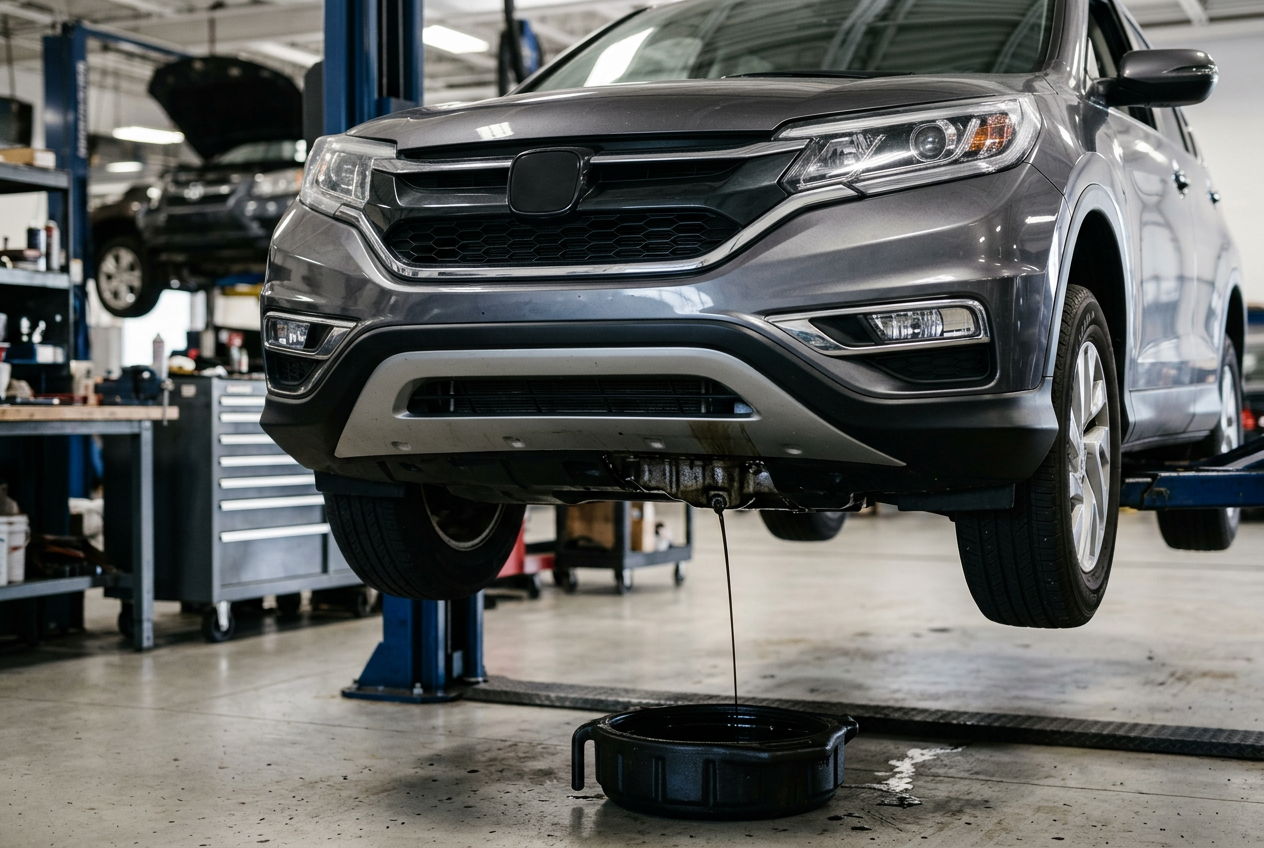
Rendered image of a Honda CR-V with a rising oil level caused by fuel dilution. Not a customer vehicle.
A gas smell in your Honda's oil, combined with a rising oil level, is a sign of fuel dilution. On the 1.5L turbocharged engine found in the CR-V, Civic, and Accord (commonly reported on roughly 2016-2020 models), raw gasoline can wash past the piston rings and mix into the crankcase oil. The most likely causes are short-trip driving in cold weather, the direct-injection and turbo combination running rich during warm-up, and the engine not reaching full operating temperature before shutdown. The result is oil that smells like gas, reads above the full mark on the dipstick, and does a worse job protecting your engine.
Which Honda models and years are affected?
The issue is commonly reported on Honda vehicles equipped with the 1.5L turbocharged four-cylinder (engine code L15B7), roughly 2016-2020. That covers the CR-V, Civic, and Accord in those years. If you own one of these and do a lot of short-trip driving, especially through a Fargo winter, you are in the group most likely to see this problem.
Why does fuel end up in the oil?
The 1.5T uses direct injection, meaning fuel is sprayed directly into the cylinder rather than into the intake port. During cold starts and short trips, the engine runs a richer fuel mixture to warm up quickly. Some of that raw fuel hits the cylinder walls before it burns completely and gets wiped down past the piston rings into the oil pan. A turbocharged engine compounds this because it takes longer to reach full operating temperature under light loads. If the engine never fully warms up before you shut it off, the cycle repeats every trip.
This is commonly diagnosed as a design interaction between the direct-injection fueling strategy, the turbocharger's thermal mass, and cold-climate short-trip use. It is not a sign that your engine is worn out, but it does mean the oil degrades faster than the oil life monitor assumes.
How does this problem progress over time?
Early stage
The oil smells faintly of gas after a string of short cold-weather trips. The dipstick reads slightly above full. The engine runs normally. Many owners miss this stage entirely.
Middle stage
The oil level climbs noticeably above the full mark. The gas smell is obvious when you pull the dipstick. You may notice slightly rough idling on cold starts or a faint fuel smell from the engine bay. Oil change intervals feel shorter than they used to.
Late stage
Severely diluted oil loses viscosity. It cannot maintain the oil film that protects crankshaft bearings and camshaft lobes. At this point you risk accelerated wear on internal engine components. Some owners also report a rough idle or hesitation that does not clear up after the engine warms.
Is it safe to keep driving?
Short trips to get the vehicle to a shop are fine. Driving for weeks or months with heavily diluted oil is not. Gasoline thins the oil, lowers its film strength, and strips away the additive package that keeps metal surfaces from contacting each other. The longer you run on diluted oil, the more wear accumulates on bearings and valve train components. If the dipstick reads more than a quarter inch above the full mark and smells strongly of fuel, change the oil before your next long drive.
What does the repair involve?
The standard repair procedure has two parts. First, an oil and filter change to remove the contaminated oil. Second, a reflash of the engine control module (ECM) to update the fueling and warm-up strategy. The software update is designed to reduce the amount of raw fuel that enters the cylinder during cold starts. On vehicles used primarily for short trips in cold climates, the update reduces the problem but may not eliminate it entirely. More frequent oil changes are part of the ongoing management plan for these engines.
What does this repair cost, and what moves the price?
| Service | Typical cost driver | Urgency |
|---|
| Oil and filter change (full synthetic) | Oil spec (Honda calls for 0W-20 full synthetic), filter brand, labor rate | Do it now if oil smells of fuel |
| ECM software reflash | Whether the update has already been applied, labor time, scan tool fees | Schedule soon after oil change |
| Diagnostic inspection | Scope of inspection, whether DTCs are present, shop rate | Recommended before reflash |
There is no single flat price for this repair without seeing the vehicle. What moves the cost most is whether the software update has already been applied (check the service history), whether any related codes are stored, and how many oil changes are needed to get the oil back to a clean baseline. We give you the full picture before any work starts.
Why is this worse in Fargo?
You already know what these winters do to a vehicle. The freeze-thaw cycle here runs from October through April, and road salt and brine are on the pavement for most of that stretch. But for the Honda 1.5T specifically, the bigger factor is cold-start behavior. When the temperature drops well below zero and you are making short runs around town, the engine almost never reaches full operating temperature before you park again. That is exactly the condition that drives fuel past the rings. A vehicle doing the same short trips in a warmer climate would see far less dilution. Here, it is just the cost of how we drive in winter.
How does Elite Automotive Center handle this?
Philip Korbel and Brian Teberg, owners at Elite Automotive Center, and the shop's ASE Certified technicians will check your oil level and condition, pull any stored codes, and verify the current software version on your ECM. If the reflash has not been done, they will walk you through what it involves and what it costs before anything is approved. Every repair at Elite Automotive Center is backed by a 3-year, 36,000-mile nationwide warranty, so if you are driving down to the Cities or out to the farm, you are covered. After-hours drop-off is available if you cannot get the vehicle in during the week.
Check your Honda's VIN for any open recalls at NHTSA's recall lookup and review maintenance schedules at the Honda Owners site. For Honda-specific service, visit our Asian vehicle repair services page or see the full list of services we offer. Learn more about the team at our about us page.
Frequently Asked Questions
Is it safe to keep driving my Honda CR-V or Civic if fuel is in the oil?
Short trips are fine in a pinch, but you should not ignore it. Diluted oil loses its ability to protect engine bearings and cylinder walls. Get the oil changed and the software checked soon.
Will a software update fix the oil dilution problem on my Honda 1.5 turbo?
A reflash of the engine control module is commonly recommended as part of the repair procedure. It adjusts fueling and warm-up strategy to reduce the amount of raw fuel that washes past the rings. It does not always eliminate the issue entirely, especially on vehicles used mostly for short trips in cold climates.
How do I know if my Honda has oil dilution and not just a high oil level?
Pull the dipstick and smell it. If it smells like gasoline rather than burnt oil, that is a strong sign. The oil may also look thinner than normal and the level will read above the full mark even if you have not added oil.
Does this affect the Honda Accord with the 1.5 turbo as well?
Yes. The issue is commonly reported on the CR-V, Civic, and Accord models equipped with the 1.5L turbocharged four-cylinder, roughly 2016-2020.
How often should I change the oil if my Honda has this problem?
More frequently than the oil life monitor suggests, especially if you make a lot of short trips or drive in cold weather. Many technicians recommend every 3,000-5,000 miles under those conditions until the root cause is addressed.
Concerned about a gas smell in your Honda's oil? Philip Korbel and Brian Teberg, owners and ASE Certified technicians at Elite Automotive Center, will check your oil level and condition, review your engine's software version, and give you a straight answer on what needs to happen next. No pressure, no surprises. Every repair is backed by a 3-year, 36,000-mile nationwide warranty.
Call us at (701) 277-3255 or get directions and schedule a visit. After-hours drop-off is available.
Sources