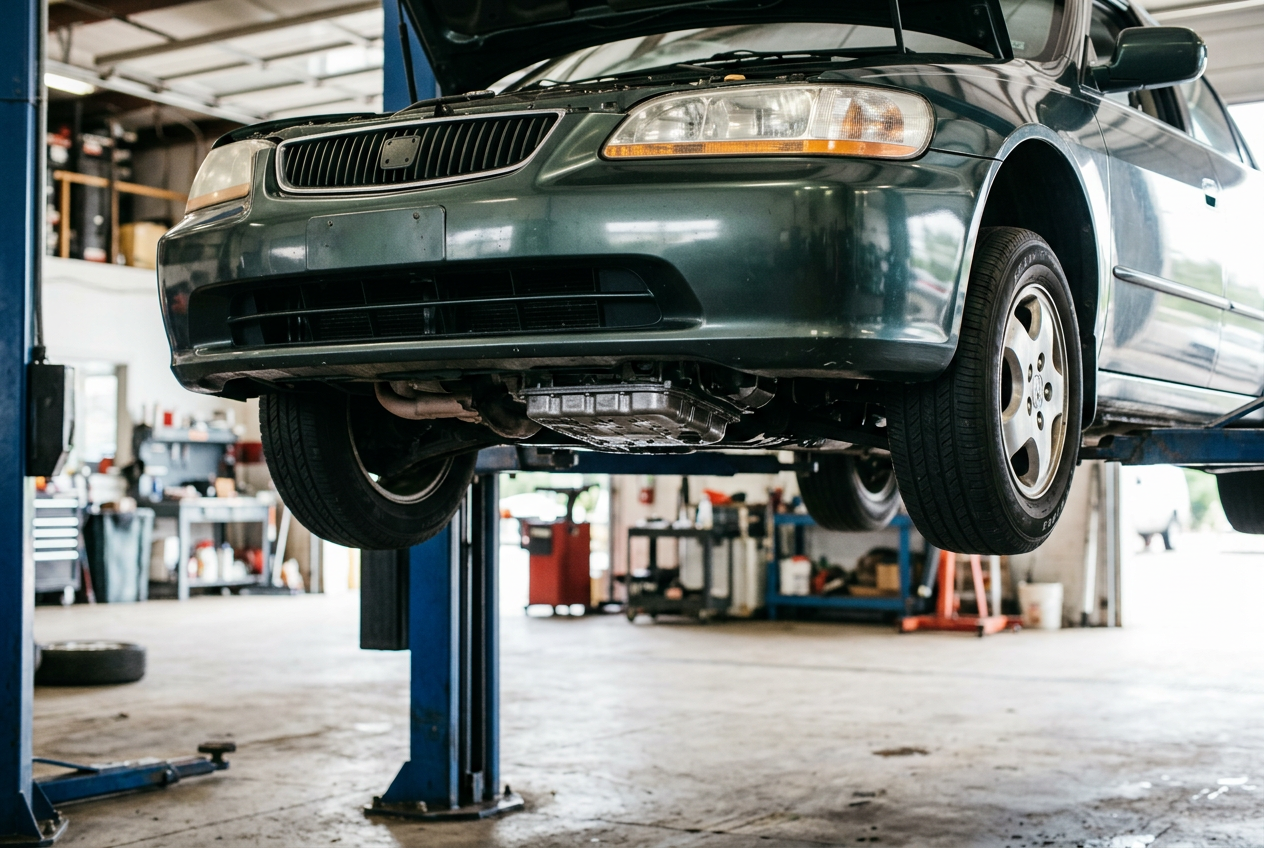
 Rendered image of a Honda Odyssey showing a transmission warning indicator. Not a customer vehicle.
A slipping, shuddering, or suddenly dead transmission in a 1999-2004 Honda or Acura V6 is commonly diagnosed as a design limitation in the five-speed automatic's cooling and clutch pack system. Early symptoms include delayed engagement, harsh upshifts, and a transmission that runs hotter than normal. The vehicles commonly reported to have this problem are the Honda Accord V6, Odyssey, and Pilot, and the Acura TL and CL, all from roughly 1999-2004. Left alone, those early symptoms lead to complete transmission failure.
Which Vehicles Are Commonly Affected?
The issue is tied to the V6 five-speed automatic, not the four-cylinder models. The vehicles commonly reported are:
- 1999-2004 Honda Accord V6 (sedan and coupe)
- 1999-2004 Honda Odyssey
- 2003-2004 Honda Pilot
- 1999-2003 Acura TL
- 2001-2003 Acura CL
If you own one of these and the transmission has never been serviced or inspected, it is worth doing that now, even if you have not noticed symptoms yet.
What Are the Early Warning Signs?
The transmission usually gives notice before it quits entirely. Catching it early keeps repair costs lower and avoids being stranded.
| Stage | Symptom | Likely Cause | Urgency |
|---|
| Early | Slight slip between 2nd and 3rd gear, especially when warm | Clutch pack beginning to wear | Inspect soon |
| Mid | Harsh or delayed shifts, transmission running hot, fluid smells burnt | Clutch material breaking down, fluid degraded | Inspect now |
| Late | Transmission slips badly or refuses to engage, warning light on | Significant internal damage, possible complete failure | Stop driving, tow to shop |
What Is Commonly Diagnosed as the Root Cause?
The issue is commonly diagnosed as inadequate heat dissipation combined with a clutch pack design that does not hold up well under sustained load. The five-speed automatic in these vehicles relies on the factory cooler circuit built into the radiator. When that circuit cannot keep fluid temperatures in a safe range, the clutch packs wear faster than they should. Fluid that has never been changed makes the problem worse, because degraded fluid loses its ability to protect clutch surfaces and transfer heat.
Is It Safe to Keep Driving?
If the transmission is slipping or shifting harshly, continued driving accelerates internal wear. Every mile in that condition grinds down clutch material and contaminates the fluid further. A short drive to a shop is reasonable. Putting off the inspection for weeks is not. If the transmission has stopped engaging a gear entirely, have it towed rather than driven.
What Does the Repair Involve?
The standard repair procedure for a transmission that has already failed or is slipping badly is a rebuild or replacement, combined with the installation of an external transmission cooler. The cooler is not optional on these vehicles. Without it, a rebuilt or remanufactured unit faces the same heat problem the original did.
The procedure typically covers:
- Drain and inspect the fluid for metal particles and burnt smell
- Remove the transmission and disassemble to assess clutch pack and valve body condition
- Rebuild with updated clutch packs and seals, or install a remanufactured unit
- Install an external transmission oil cooler
- Refill with the Honda-specified automatic transmission fluid for your model year
- Road test and verify shift quality across all gears
What Does This Repair Cost?
Cost varies based on several factors, and there is no honest single number without inspecting the vehicle first. Here is what moves the price:
- Rebuild vs. replacement: A rebuild of the existing unit costs less than a remanufactured replacement, but only if the case and major components are still serviceable.
- External cooler: Adding a cooler adds parts and labor, but it is considered standard practice on this repair.
- Fluid specification: Honda-specified automatic transmission fluid costs more than generic fluid, but it is the correct specification for these units.
- Labor rate: Transmission removal and installation is a multi-hour job regardless of what is found inside.
The only way to get an accurate number is to have the transmission inspected, the fluid checked, and the extent of internal wear assessed before any work begins.
Should I Check Whether Honda Covers This?
Because the recall and warranty-extension status for this issue is still being verified, we cannot confirm what coverage, if any, Honda currently offers. Before paying for any repair, check your VIN at nhtsa.gov/recalls and call a Honda dealer directly with your VIN to ask whether any open coverage applies to your vehicle. Coverage is typically VIN-specific and time-limited, so the dealer is the only reliable source for a current answer.
Why Does This Come Up in Fargo?
Road salt and liquid brine on Fargo roads from October through April put the entire drivetrain under constant chemical stress. Transmission cooler lines, external cooler fittings, and the pan itself are all exposed to that environment. It is the practical cost of driving here. When a transmission is already running hot due to the design issue described above, corroded cooler lines that restrict flow make the heat problem worse. An inspection should include the cooler circuit and lines, not just the fluid and internal condition.
How Elite Automotive Center Handles This
Philip Korbel and Brian Teberg, owners of Elite Automotive Center and ASE Certified technicians, and the team at Elite Automotive Center will check fluid condition, scan for any stored codes, and give you a clear picture of what the transmission needs before any work is approved. The shop operates as a NAPA AutoCare Center and an O'Reilly's Certified Auto Repair Center, and all transmission repairs are backed by a 3-year, 36,000-mile nationwide warranty. After-hours drop-off is available if getting the vehicle in during the day is difficult. You can reach the shop at (701) 277-3255 or visit the services page for more on what Elite Automotive Center covers. For Subaru owners with similar drivetrain concerns, the Subaru repair services page has more detail. For directions and scheduling, use the contact and directions page. More about the team is on the about us page.
Frequently Asked Questions
Can I keep driving my Honda if the transmission is slipping?
Short trips to a shop are generally okay, but continued driving with a slipping transmission accelerates internal damage and can lead to complete failure. Get it inspected as soon as possible.
Does Honda still cover this transmission failure for free?
Because this topic is still being verified, we cannot confirm current recall or warranty-extension status. Check your VIN at nhtsa.gov/recalls and call a Honda dealer with your VIN to ask about any open coverage before paying for repairs.
What does a transmission rebuild versus a replacement cost?
Cost varies based on whether the unit is rebuilt or replaced with a remanufactured unit, whether an external cooler is added, and local labor rates. There is no single number without inspecting the vehicle first.
Which Honda and Acura models are affected?
The issue is commonly reported on the 1999-2004 Honda Accord V6, Odyssey, and Pilot, and the Acura TL and CL from the same era, all equipped with the V6 five-speed automatic.
Will adding a transmission cooler prevent the problem?
An external cooler reduces heat load and is a standard part of the repair procedure. On its own it will not fix an already-damaged transmission, but it is considered essential when rebuilding or replacing the unit.
Ready to get your Honda or Acura transmission inspected? Call Elite Automotive Center at (701) 277-3255 or schedule a visit online. Philip Korbel and Brian Teberg and the team will inspect the transmission, check fluid condition, and give you a straight answer on what it needs before any work begins. After-hours drop-off is available. All repairs are backed by a 3-year, 36,000-mile nationwide warranty.
Sources